AstroHelper
AstroHelper — session planning
AstroHelper is a session-planning tool for astrophotographers. Clear nights and backyard time are limited, so the goal is to spend less of it figuring out what's worth imaging and more of it actually imaging.
The idea came from my own backyard, which has a number of trees blocking the horizon. Rather than manually cross-checking planetarium software against my sky view every time I wanted to shoot, I built a tool that does it for me.
You can visit the live version of AstroHelper here.
How It Works
AstroHelper combines four inputs to figure out what's worth pointing a telescope at tonight:
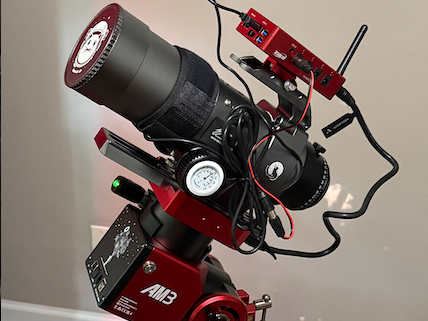
- Equipment : your optical setup's capabilities, so recommendations fit what you're actually shooting with
- Site horizon : an uploaded panorama of your sky, so obstructions like trees and rooflines are accounted for
- Live weather : real-time conditions for the night in question
- Light pollution : local sky darkness on the Bortle scale
From there, it outputs a list of recommended deep-sky objects along with suggested start and stop times for imaging each one.
Design Philosophy
AstroHelper leans on standard rules of thumb: aperture-based limiting magnitude, field-of-view fit, Bortle/narrowband interaction, and Moon interference — rather than a rigorous simulation. No AI is used.
It's meant to narrow down a shortlist quickly, not replace judgment: I'd still recommend sanity-checking its recommendations against your own experience and cross-referencing with planetarium software.
Under the Hood
AstroHelper is built on a handful of open data sources and libraries:
- OpenNGC : deep-sky object catalog
- Open-Meteo : weather and geocoding
- OpenStreetMap Nominatim : reverse geocoding
- Astronomy Engine : astronomy calculations
- Digitized Sky Survey / NASA-JPL imagery : object thumbnails
Privacy
Your data stays local to the browser. The only thing sent externally is your location's coordinates, used to fetch weather.